

Clear and hassle-free advice for GPs
Doctors
Clear and hassle-free advice for GPs
Shipleys have been using their specialist knowledge in the healthcare sector for over 10 years. We act for GPs practices of all sizes from small single handed practices to larger partnerships and corporates, as well as Pharmacy linked GP practices, health clinics and consultants.
The health industry has seen a surge in growth in recent years, achieved against a back drop of challenges from fundamental reforms to the NHS. GPs need to be proactive with their business model and look to provide more of the advanced and enhanced services on top of essential services to maintain incomes and profitability.
Sections
- GPs Principals and Practices
- GP Locums, Registrars and Consultants
- Tax planning services for Doctors
GPs Principals and Practices
At Shipleys Tax we understand the specific needs of general practices and the partners involved. Fundamental reforms to the NHS mean GP practices need to continuously re-position themselves under the new system and be able to devote maximum time to administration of patient care. This is where our team can help by providing specialist knowledge on streamlining accounting and tax matters leaving GPs to concentrate on patient care.
Why do you need a specialist GP accountant?
• Knowledge of NHS general practice and the expert advice we provide can be instrumental
• Understanding how practices are funded (from global sum to QOFs ).
• Be familiar with the GP contract reforms, GMS statement of financial entitlements, PMS contracts and the NHS pension scheme.
• Be up to speed on practice based commissioning (PBC), APMS contracts and the developing primary care market.
• Deal competently and promptly with all taxation matters and with GPs’ superannuation.
Why us?
We aim to do more than produce the annual accounts and handle the partners’ tax affairs.
Personal service – you will deal with one particular partner and their same support team and not be passed around
Timely – the annual accounts will be prepared to agreed time scales and we will visit the practice to discuss
Prompt – we will deal promptly with routine queries, telephone calls and emails and advise on bookkeeping, cash flow and monitoring partners’ drawings without making additional charges.
Tax planning – we will discuss ways to minimise your overall tax liability and spot opportunities.
We have nationwide coverage and are happy to come and visit you.
Cost
What our basic annual fee covers:
• Annual accounts preparation.
• Meeting GPs to discuss draft accounts.
• Partnership tax return and tax computation..
• Advising on projected profits and tax liability.
• Dispensary accounts.
• Partners’ personal tax returns.
• GP certificate of NHS pensionable income.
• Ad hoc email and telephone queries
• Opportunities for tax planning for both business and personal affairs
We also advise on:
• VAT accounting.
• Setting up a limited company for non-NHS or locum income.
• Setting up a limited company social enterprise for PBC/APMS purposes.
• Handling HM Revenue & Customs’ investigation into the practice.
• Payroll
• NHS superannuation
• Specific tax planning strategies for reducing IHT, CGT and Stamp Duty
GP Locums, Registrars and Consultants
We have acted for GP Locums, Consultants and Registrars for many years and understand the needs of the medical profession.
As a GP Locum, Registrar or consultant you have very specific accounting and tax needs which may not necessarily be appreciated by a non specialist advisor.
What does the service include?
• Advising on employed vs self employed status and NIC implications
• Proactive advice on tax allowable business expenses, professional subscriptions and general tax planning for locums
• Advice on employing a spouse
• Preparation of annual Accounts and tax returns for HMRC
• Ad hoc telephone and email advice
As well as providing accounting and income tax advice we can also advise on the following areas:
• Incorporation of your business via a limited company
• Advice on tax treatment of superannuation
• Advice on completing superannuation certificates (GP solo, Forms A&B)
• Inheritance tax planning
• Property tax planning
We have nationwide coverage and act for GP Locums, Registrars and Consultants clients based throughout the UK.
Why us?
• Save you money – proactive services ensuring you are aware of tax savings
• Knowledge you can rely on – we have a wealth of tax expertise in the healthcare sector
• Planning – ensuring you are aware of tax liabilities and payment dates enabling you to plan your cashflow
• Peace of mind – we have many years of experience in dealing with the tax affairs of medical and hospital consultants
• Help you minimising risk of HMRC enquiry
Our fees start at £345 + VAT
Tax Planning for Doctors
Tax law never stands still and goal posts are always moving. It is crucial that you have the right adviser to guide you through the maze and help reduce your tax bill through legitimate and transparent means.
Shipleys Tax has a number of specialist tax advisers with wealth of experience in the medical sector who can talk to you about the many tax saving opportunities.
We always say the best tax planning is done before a major event in the business so seek advice early on in the lifecycle of a transaction. Some areas to consider:
• Buying or Selling a GP practice property – huge tax saving opportunities both personal and corporation tax (NB: patient lists cannot be sold)
• GP linked pharmacies – most tax efficient trading structures
• Reduce inheritance tax on death
• Reduce stamp duty land tax on buying
• Offshore tax planning advice for certain businesses
• Provide property development strategies
• Use of EIS/SEIS and corporate venture vehicles
• Use of LLPs and corporate partnerships
• Asset protection and preservation of wealth
• Estate planning and succession
Latest news & blogs…
BEWARE OF STAMP DUTY SCAM 

ANYONE THAT has recently purchased a property needs to be aware of stamp duty scam doing the rounds. HMRC is warning housebuyers to be wary of cold callers, or social media ads, claiming that they are owed a refund of stamp duty land tax.
While such firms in many cases may be legitimate, they tend to charge a sizeable fee on any refunds receivable. This is almost always disproportionate to the work undertaken as such claims can be made directly by completing a simple form.
So what do homeowners need to watch out for?
HMRC has long warned taxpayers about so-called “high volume” tax repayment companies. These are companies that have a very limited purpose – usually attracting people in with the promise of large tax refunds of unclaimed allowances, e.g. for uniforms or the marriage allowance.
While such firms in many cases may be legitimate, they tend to charge a sizeable fee on any refunds receivable. This is almost always disproportionate to the work undertaken as such claims can be made directly by completing a simple form.
However, some supposed refund firms are actually fraudsters with questionable motives. HMRC is now warning about a recent spate of stamp duty tax refund claims that have not met the criteria for a refund. These usually prey on the unsuspecting public via cold calling or social media ads.
One such method that Shipleys Tax have encountered appears to be where the scammer approaches a homeowner claiming that they could be eligible for “multiple dwellings relief” for extremely spurious reasons, e.g. because a bedroom has an en-suite bathroom or a built-in wardrobe which “could be used as a kitchen” etc. While these claims may simply be rejected outright, the worry is that in some cases the refund is initially processed, the scammer takes their “fee”, and the homeowner then receives a demand for repayment of the refund, with interest and possibly even penalties. Naturally, by then the potential scammer has then disappeared.
Anyone receiving such a letter or being approached should refer it to the professional that handled their conveyance to ensure nothing has been missed. We also advise them to contact a tax specialist for guidance. We would also reiterate that are also many legitimate firms who genuinely work to recover tax refunds and provide a thoroughly professional service.
If you are affected by any of the issues above and would like more information, please call 0114 272 4984 or email info@shipleystax.com.
Please note that Shipleys Tax do not give free advice by email or telephone.
Getting VAT back on Electric Cars

CLIMATE CHANGE and sustainability are currently on everyone’s agenda, with society being encouraged to take steps to reduce its carbon footprint wherever possible.
As part of this, the Government has introduced various tax reliefs and favourable treatments for electric cars, encouraging business owners and individuals to opt for the new Tesla or Porsche Taycan as opposed to the petrol or diesel alternatives.
In today’s Shipleys Tax blog, we consider one of the most frequently asked VAT question: whether VAT can be reclaimed on the purchase or lease of electric cars. Note, the comments below are intended only to be a general guide and not advice on a VAT reclaim.
…we consider one of the most frequently asked VAT question: whether VAT can be reclaimed on the purchase or lease of electric cars.
VAT reclaim on electric vehicles
From a VAT perspective there are no special reliefs relating to electric vehicles. So currently, electric vehicles are subject to the same rates of VAT as their diesel or petrol counterparts, i.e. 20%. Further to this, the rules for reclaiming VAT incurred on an electric vehicle depends on whether it is purchased or leased and is the same as for non-electric vehicles:
- Leased cars – where an electric car on lease is available for any private use, only 50% of the VAT paid can be recovered. This is to take into account the private element of the vehicles use. Note however, VAT paid on any servicing or maintenance charge can be recovered in full. As such it is more tax efficient to ensure that a service contract is taken separately to the lease.
- Purchased cars – where an electric car is purchased but available for private use (e.g., has private insurance, is kept at home over night etc) no VAT is reclaimable. This includes cars purchased outright, hire purchase cars and generally personal contract purchases.
- Commercial vehicles – commercial electric vehicles such as vans, lorries etc with incidental private use are entitled to full VAT recovery. It is worthwhile noting that for VAT purposes commercial vehicles also include certain types of pick-up trucks and modified cars.
…where an electric car on lease is available for any private use, only 50% of the VAT paid can be recovered. This is to take into account the private element of the vehicles use.
How to reclaim all the VAT on electric cars
This is a complex area and quite beyond the scope of this blog. However, in some very specific circumstances, businesses may be entitled to recover full VAT on electric cars. This is where businesses can show that the car is used wholly for business and NOT available for private use. Typically this applies only to “pool cars” and cars use in a trade (e.g., taxi or vehicle leasing business). Whilst in theory it may be possible to argue 100% recovery on other cars under the “wholly for business” case, in practice it is a different matter altogether. Detailed evidence would need to be maintained proving the car is only available strictly for business and no private use is allowed. This could be for example ensuring the car is only insured for business journeys, or the car is only kept overnight at business premises, or contractual restrictions provide that the business only journeys are allowed. There is no standard process here and HMRC would certainly look to challenge the VAT treatment, as such this is an exception rather than the rule and would need careful planning.
…in some very specific circumstances, businesses may be entitled to recover full VAT on electric cars. This is where businesses can show that the car is used wholly for business and NOT available for private use.
Charging electric vehicles: Reclaiming VAT
HMRC currently allow recovery on VAT on electric charging costs on the following basis:
Home charging
VAT incurred on charging an electric vehicle at home for sole traders and or partners in a business can be recovered on the business miles only. As such, HMRC expect detailed mileage records to be kept showing the private use.
This does not apply to employees of a business as the supply of the electricity in this case is made directly to the individual employee and not the business, therefore does not meet the business test.
Public charging
Business miles incurred by sole traders, partners and employees can reclaim the VAT they incur when charging their vehicles at a public charging point. Mileage records detailing the business usage should be kept supporting the reclaim.
VAT incurred on charging an electric vehicle at home for sole traders and or partners in a business can be recovered on the business miles only.
Charging at a business premises
Where vehicles are charged at the business’s premises, and are used for business and private mileage, a record detailing business and private use should be kept.
The business has two options in this case as follows:
- The business can restrict the VAT it claims on electricity and reclaim VAT only on the electricity used for business purposes; or
- Reclaim all VAT on the cost of electricity and pay output VAT to HMRC on any electricity used privately.
HMRC to ease VAT burden?
Currently, these methods for VAT recovery involve significant amount of record keeping and administration for what is potentially small amounts of VAT recovery. HMRC have taken note of this and are considering simplifications which may reduce the burden of evidence on currently imposed – so watch this space.
If you are planning on purchasing or leasing an electric vehicle and would like to know whether you can recover the VAT, please call 0114 272 4984 or email info@shipleystax.com.
Please note that Shipleys Tax do not give free advice by email or telephone.
Business Asset disposals tax investigations
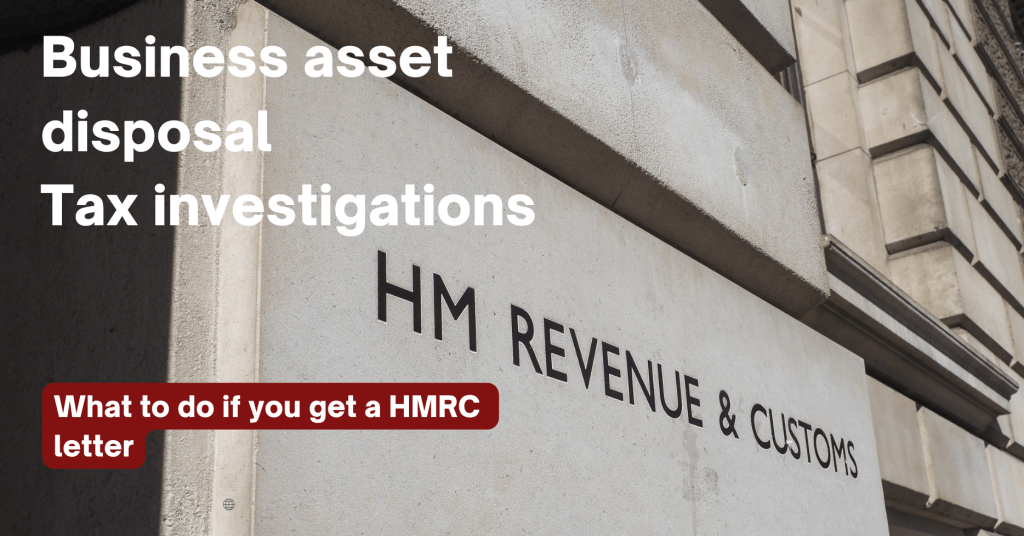
SELLING PART or all your business can be fraught with tax and legal issues. One aspect which many get wrong is the extremely valuable tax relief on disposal of a business asset. The relief, known as business asset disposal relief (“BADR”), has a lifetime limit of £1 million – an amount which was reduced in 2020. Now, HMRC is sending letters to individuals who claimed this relief in 2020/21, warning that they may have underpaid tax.
In today’s Shipleys tax brief we look at what’s going on and what should you do if you are unfortunate to receive a letter.
Now, HMRC is sending letters to individuals who claimed this relief in 2020/21, warning that they may have underpaid tax.
What is business asset disposal relief?
Business asset disposal relief was previously known as Entrepreneurs’ relief (ER). This was revamped in 2020 and, aside from being rebadged as BADR, there was no change to the underlying mechanics of the relief. However, the primary change was that the cumulative lifetime limit for gains (i.e., “profits”) on disposal of qualifying assets was slashed from £10 million to £1 million. This did not affect gains arising before 11 March 2020. So, for example, if a gain of £8 million had been realised on 10 March, it could qualify in full, but the unused £2 million disappeared the next day!
…the primary change was that the cumulative lifetime limit for gains (i.e., “profits”) on disposal of qualifying assets was slashed from £10 million to £1 million.
What’s the problem?
HMRC is seemingly concerned that taxpayers (and by extension, their advisors) may not have understood that the reduced £1 million limit had to include gains arising prior to 11 March 2020, i.e. it was a retrospective test. It is now writing to taxpayers that claimed BADR in 2020/21 that it believes fall into one of two sets of circumstances:
- more than £1 million of gains have already been subject to an ER claim prior to the change, meaning the allowance for 2020/21 was £nil; or
- where less than £1 million gains were previously subject to a claim, but the claim in 2020/21 means the limit has been exceeded, e.g. where, say, £500,000 had previously been claimed, then a claim for £1 million was made in 2020/21.
HMRC is seemingly concerned that taxpayers (and by extension, their advisors) may not have understood that the reduced £1 million limit had to include gains arising prior to 11 March 2020…
What should you do if you get a letter?
Although, this type of “nudge” letter is usually a precursor to the opening of a formal enquiry, you should not panic. Anyone receiving a letter should check their BADR/ER claim history (back to 2008) to check the position and amend their return if necessary. We recommend you promptly speak to a tax advisor to establish the position and determine the best course of action.
If you do so, although there will be late payment interest, it appears that no penalties will be charged as long as the correction is made before a compliance check is started.
What no to do would be to ignore the letter hoping HMRC will go away. They won’t. This type of “fishing” exercise conducted by HMRC is based on yielding returns and HMRC will not relent until it is satisfied there is no potential tax underpayment at stake.
If you are affected by any of the issues above and would like more information, please call 0114 272 4984 or email info@shipleystax.com.
Please note that Shipleys Tax do not give free advice by email or telephone.
Testimonials
“We value the close working relationship we have with Shabeer and the specialist teams at Shipleys Tax...(read more)
Dr K, GP Surgery – Yorkshire
“One of the most frequent issues we had with our previous accountants was not being made aware, in advance... (read more)
FM Medical Practice – Manchester
“Accountants seem to promise the earth but don’t deliver do they? Well we found the opposite. Abdul made himself... (read more)
Mrs Khan – JL Healthcare
Contact us
